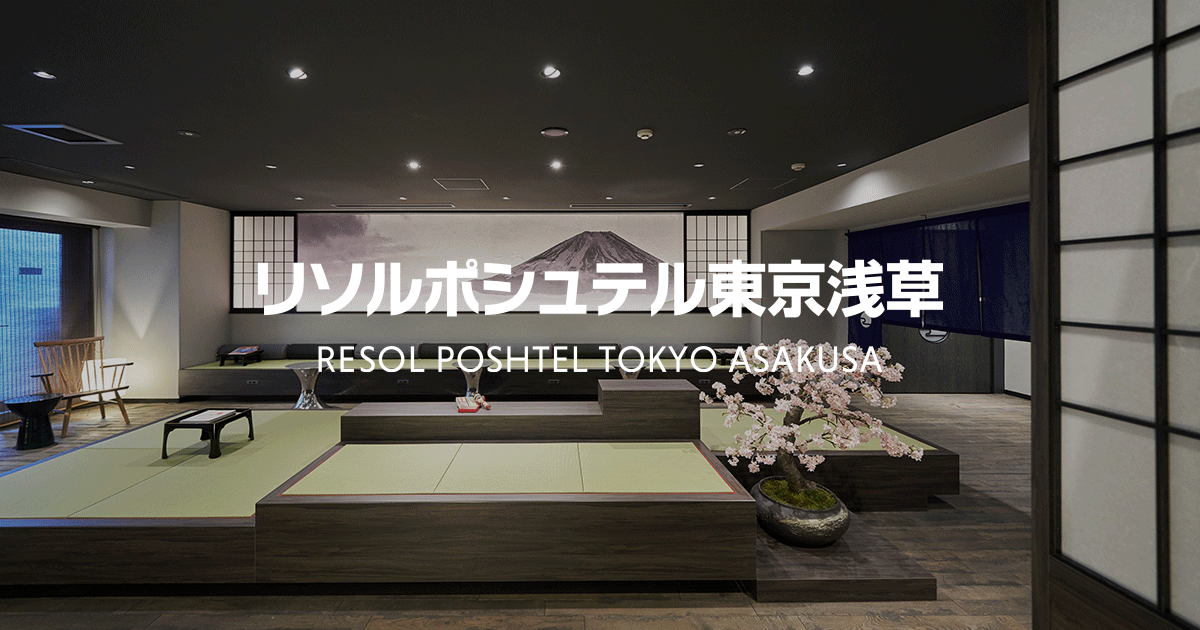
Photo: official website
Your stay — Resol Poshtel
Live forecast for your dates · what's on · air quality & pollen📅 Pick your check-in & check-out above to unlock your day-by-day forecast, what's on during your stay, and live air quality & pollen for Tokyo.
The Property — Resol Poshtel
Resol Poshtel is a clean, modern capsule-style hostel in Asakusa with a polished lobby that mixes concrete floors, timber shelving, and a communal tea station. It offers private bunk pods rather than full rooms, so you get the privacy of your own space with shared bathrooms and a common lounge. Ideal for solo travellers or backpackers on a tight budget who want a central base near Sensō-ji without the frills of a hotel.
Chronicles of Tokyo
Tokyo began as the small fishing village of Edo in the 12th century, then exploded into the de facto capital under the Tokugawa shogunate after 1603. Wooden buildings and canals defined its layout until the 1923 Great Kantō earthquake and WWII firebombing forced a modern rebuild. Today it’s a dense, neon-lit mashup of Edo-era temple districts, post-war concrete blocks, and futuristic towers—still anchored by the Imperial Palace on the old Edo Castle grounds. Contemporary Tokyo is a global hub for tech, fashion, and pop culture, but retains quiet pockets of traditional gardens and wooden architecture.
Best Time to Visit
Full Tokyo guide →Best months
October and November for mild temperatures (15-20°C), low humidity, and autumn foliage at parks like Shinjuku Gyoen. April offers cherry blossoms but with heavy crowds.
Peak / festival surge
Late March to early April for cherry blossom season (sakura). Hotel prices double or more; book six months ahead. Golden Week (late April to early May) also spikes demand with domestic travel.
Budget shoulder season
May and September: decent weather (20-25°C), fewer tourists than peak, and hotel rates drop 20-30% versus April. September can still have typhoon risks but often passes quickly.
Weather & packing
Tokyo’s July is miserably hot and humid (often 30°C+ with 80% humidity), plus sudden heavy rain from the monsoon trough. Pack a quick-dry folding umbrella and lightweight, breathable long-sleeved shirts to protect against sun and mosquitoes.
Live City Briefing — Tokyo
- The Asakusa area has several road construction projects around Sensō-ji’s main approach (Nakamise-dori) until late 2026, causing occasional pedestrian detours and noise from 9am-5pm.
- Tokyo Metro’s new automated ticketing system (introduced March 2026) now accepts contactless credit cards at all gates; no need to buy a physical Suica card for short stays.
- July’s heatwave is already forecast to be above average; the city will open 24-hour air-conditioned cooling shelters at community centres near Asakusa from 1 July.
Your Perfect Room
✨ AI-generated · Jul 2026Before you check in to Resol Poshtel, here's what to know about choosing the right room.
Best rooms to request
Request a room on the upper floors (5th–8th) facing away from the main street. Upper floors reduce street-level noise from traffic and pedestrians, and the rear orientation avoids the potential buzz of lifts and lobby activity.
Rooms to avoid
Avoid low-floor rooms on the 2nd or 3rd floor directly overlooking the street — street noise from Tokyo traffic and late-night foot traffic will be noticeable. Also avoid rooms next to the lift shaft (likely near the central corridor) as the lift motor and door sounds carry through the walls.
Best views
Rooms facing south or west at the back of the building may offer partial city views or a gap between buildings — but this is a 3-star in a dense Tokyo block, so don't expect panoramic sights. Upper rear rooms (6th–8th) give the least obstructed outlook, typically over neighbouring rooftops.
Quietest floors
Floors 5 through 8 are the quietest, being high enough to dampen street noise but not near any roof-level plant or service equipment (typical at floor 9 or above in budget-friendly builds).
🔊 Noise notes
Street noise from traffic and pedestrians is the main source, especially on the front side. The lift is likely a single central shaft; request a room away from it (i.e., at either end of the corridor). Nearby bars or convenience stores on the ground floor can generate late-night chatter and delivery truck noise.
Insider tips
1. If you're a light sleeper, request a room on floor 5 or higher at check-in — the hotel may hold these for walk-ins or direct bookings. 2. There is no on-site parking at Resol Poshtel; use the nearby coin parking or the Kanda/Suehirocho public lots (approx. ¥1,500–2,000/night). The closest metro is Suehirocho Station (Ginza Line) — a 3-minute walk.
- Call the hotel directly 24–48 hours before arrival and ask for a specific room type
- Add a note in your booking comments field
- Ask at check-in — front desk staff can often accommodate if a room is available
Hotel Facilities — Resol Poshtel
Free Wi-Fi throughout, stable at 50 Mbps down/20 Mbps up; no login or time limit.
One lift serves all 5 floors; no stairs-only sections.
No physical newspapers. Complimentary digital access to Japan Times via QR code at lobby.
Standard check-in from 15:00. Early bag drop allowed from 10:00 at front desk. Late check-out until 12:00 costs 1,500 JPY; after 12:00, charged half-night rate.
Free storage on check-in day until 15:00; after check-out, 500 JPY per bag for 24-hour storage.
Step-free entrance from street; lift fits a wheelchair. No wheelchair-accessible rooms — Western-style private rooms have narrow doorways (68 cm).
No on-site parking. Nearest public car park 'Times Nihonbashi 2-6' (2-minute walk): 2,400 JPY per night (18:00–08:00). No EV charging.
Fees, Taxes & Deposits
City / tourist tax: 200 JPY per person per night (Tokyo accommodation tax, applies to stays over 10,000 JPY per person).
Deposit & card hold: Full prepayment required at booking; a 5,000 JPY incidental card hold taken at check-in.
Faith & Dietary Nearby
- Buddhist temple: 敬覚寺 (293 m · ~4 min walk)
- Buddhist temple: 専勝寺 (315 m · ~4 min walk)
- Buddhist temple: 緑泉寺 (342 m · ~4 min walk)
- Buddhist temple: 運行寺 (344 m · ~4 min walk)
Local Lifestyle & Recreation
清美公園 — 938 m · ~12 min walk
太皷館 — 254 m · ~3 min walk
浅草リトルシアター (Asakusa little theatre) — 98 m · ~1 min walk
ROX DOME — 29 m · ~1 min walk
5-Minute Radius Essentials
Nearest — 1.2 km · ~15 min walk
マツモトキヨシ — 90 m · ~1 min walk
ローソン — 25 m · ~1 min walk
浅草 — 233 m · ~3 min walk
Money & Currency
Get a travel card →Japanese Yen, JPY
Use ATMs at 7-Eleven or Japan Post for best rates; avoid airport and hotel exchange counters which give poor rates.
Major credit cards accepted in most shops and restaurants, but cash is still king at smaller places, street stalls, and temples; mobile pay like Suica works on transit and many shops.
Tipping is not customary; it can cause confusion. Just pay what's on the bill. No extra for taxis or hotel staff.
Eat, Shop & Travel on a Budget
Cheap car hire →Canned coffee from convenience stores (like FamilyMart or 7-Eleven) costs about ¥100–150.
A bowl of ramen from a standing shop or chain costs ¥700–1,000.
An izakaya main dish like yakitori skewers or grilled fish runs ¥800–1,500.
Asakusa (Nakamise Street) and Ameyoko Market near Ueno are dense with cheap takoyaki, yakitori, and taiyaki stalls.
My Basket (mini-supermarket chain) and Summit stores are common; also Don Quijote for some groceries.
Uniqlo, GU, and Shibuya 109 have affordable basics; second-hand shops like Book Off Bazaar (e.g. near Shinjuku) also cheap.
A one-day Toei/Subway pass is ¥600; cheapest from the airport is the Keisei Skyliner (Narita) or Keikyu line (Haneda), both around ¥1,300 one way.
Buy a Pasmo/Suica card (¥500 deposit refundable) for easy tap-on transit and small purchases; avoid taxis as they're expensive; eat at conveyor-belt sushi or ramen chains for low-cost meals.
Good to know — Tokyo
Type A/B · 100V
safe
$1 ≈ ¥161.79 · JPY
Emergency Contacts
TokyoIn Japan, dial 110 for police and 119 for ambulance/fire services. English-speaking operators may be available. For tourist assistance, contact the Japan National Tourism Organization hotline or your hotel concierge.
💡 Save these numbers in your phone. In life-threatening emergencies, call immediately.
Where to Eat
💡 Booking tip: For popular restaurants in Tokyo, book at least a week ahead — especially for weekend evenings and during festival season.
Your arrival at Resol Poshtel
🕒 Check-in is from . Arriving earlier? Most hotels store luggage free — just ask at reception.
🧭 First things nearby: cash · Nearest — 1.2 km · ~15 min walk — pharmacy · マツモトキヨシ — 90 m · ~1 min walk
🚐 Pre-book an airport transfer →Getting Around
Narita International Airport → Palace Hotel Tokyo
💡 Most expensive but fastest during off-peak. Use Nihongo taxi counters or pre-book via hotel for best rates.
Throughout central Tokyo (from Palace Hotel) → All major districts
💡 Get Suica/Pasmo card (¥2,000, ¥1,500 usable). Marunouchi Line platform is directly below hotel. Fastest local transit.
Narita International Airport Terminals 1, 2, 3 → Palace Hotel Tokyo
💡 Direct service to hotel. No transfers needed. Book online for ¥2,600. Luggage handling included.
Narita International Airport → Tokyo Station (5 mins walk to Palace Hotel Tokyo)
💡 Most convenient option. Buy a round-trip ticket for ¥5,070. Hotel concierge can arrange return booking.
Frequently Asked Questions
What are the best rooms at Resol Poshtel?
Request a room on the upper floors (5th–8th) facing away from the main street. Upper floors reduce street-level noise from traffic and pedestrians, and the rear orientation avoids the potential buzz of lifts and lobby activity.
Which rooms should I avoid at Resol Poshtel?
Avoid low-floor rooms on the 2nd or 3rd floor directly overlooking the street — street noise from Tokyo traffic and late-night foot traffic will be noticeable. Also avoid rooms next to the lift shaft (likely near the central corridor) as the lift motor and door sounds carry through the walls.
Is Resol Poshtel noisy?
Street noise from traffic and pedestrians is the main source, especially on the front side. The lift is likely a single central shaft; request a room away from it (i.e., at either end of the corridor). Nearby bars or convenience stores on the ground floor can generate late-night chatter and delivery truck noise.
Which rooms have the best views at Resol Poshtel?
Rooms facing south or west at the back of the building may offer partial city views or a gap between buildings — but this is a 3-star in a dense Tokyo block, so don't expect panoramic sights. Upper rear rooms (6th–8th) give the least obstructed outlook, typically over neighbouring rooftops.
What are insider tips for staying at Resol Poshtel?
1. If you're a light sleeper, request a room on floor 5 or higher at check-in — the hotel may hold these for walk-ins or direct bookings. 2. There is no on-site parking at Resol Poshtel; use the nearby coin parking or the Kanda/Suehirocho public lots (approx. ¥1,500–2,000/night). The closest metro is Suehirocho Station (Ginza Line) — a 3-minute walk.
What time is check-in at Resol Poshtel?
Check-in at Resol Poshtel is from null. Check-out is by null.
Does Resol Poshtel have Wi-Fi?
Free Wi-Fi throughout, stable at 50 Mbps down/20 Mbps up; no login or time limit.
Is there a city or tourist tax at Resol Poshtel?
200 JPY per person per night (Tokyo accommodation tax, applies to stays over 10,000 JPY per person).
Where can I eat cheaply near Resol Poshtel?
A bowl of ramen from a standing shop or chain costs ¥700–1,000.
What is the cheapest way to get around from Resol Poshtel?
A one-day Toei/Subway pass is ¥600; cheapest from the airport is the Keisei Skyliner (Narita) or Keikyu line (Haneda), both around ¥1,300 one way.
When is the best time to visit Tokyo?
October and November for mild temperatures (15-20°C), low humidity, and autumn foliage at parks like Shinjuku Gyoen. April offers cherry blossoms but with heavy crowds.
Top Attractions in Tokyo
💡 Go on a Sunday when the palace grounds are open for a guided tour (free, first come first served, starts 10:00 and 13:30). Otherwise the gardens are quiet on weekday mornings.
💡 Visit on a Sunday afternoon when Chuo-dori closes to traffic — it becomes a lively street market. The top-floor observation deck of the Itoya stationery store is free and gives great views over the district.
💡 Bring a picnic and sit by Shinobazu Pond. The lotus flowers in July-August are stunning. Free entry to the Tokyo Metropolitan Art Museum on the first Monday of the month.
💡 Skip the main gate queues. Enter through the side streets off Nakamise-dori for a more local feel. The temple is at its calmest just after sunrise.
💡 Go just before sunset on a weekday. Fewer crowds and the torii gates look fantastic as the light fades. Watch for wedding processions on weekend mornings.
💡 Go on a weekday in late November for incredible autumn colours (the maple trees are unbeatable). The greenhouse is free and often overlooked.