🇨🇷 Puntarenas, Costa Rica
Shipwrecked Hostel
📍 Carretera Pacífica Fernández Oreamuno, Puntarenas, 60504
Photo: official website
Your stay — Shipwrecked Hostel
Live forecast for your dates · what's on · air quality & pollen📅 Pick your check-in & check-out above to unlock your day-by-day forecast, what's on during your stay, and live air quality & pollen for Puntarenas.
The Property — Shipwrecked Hostel
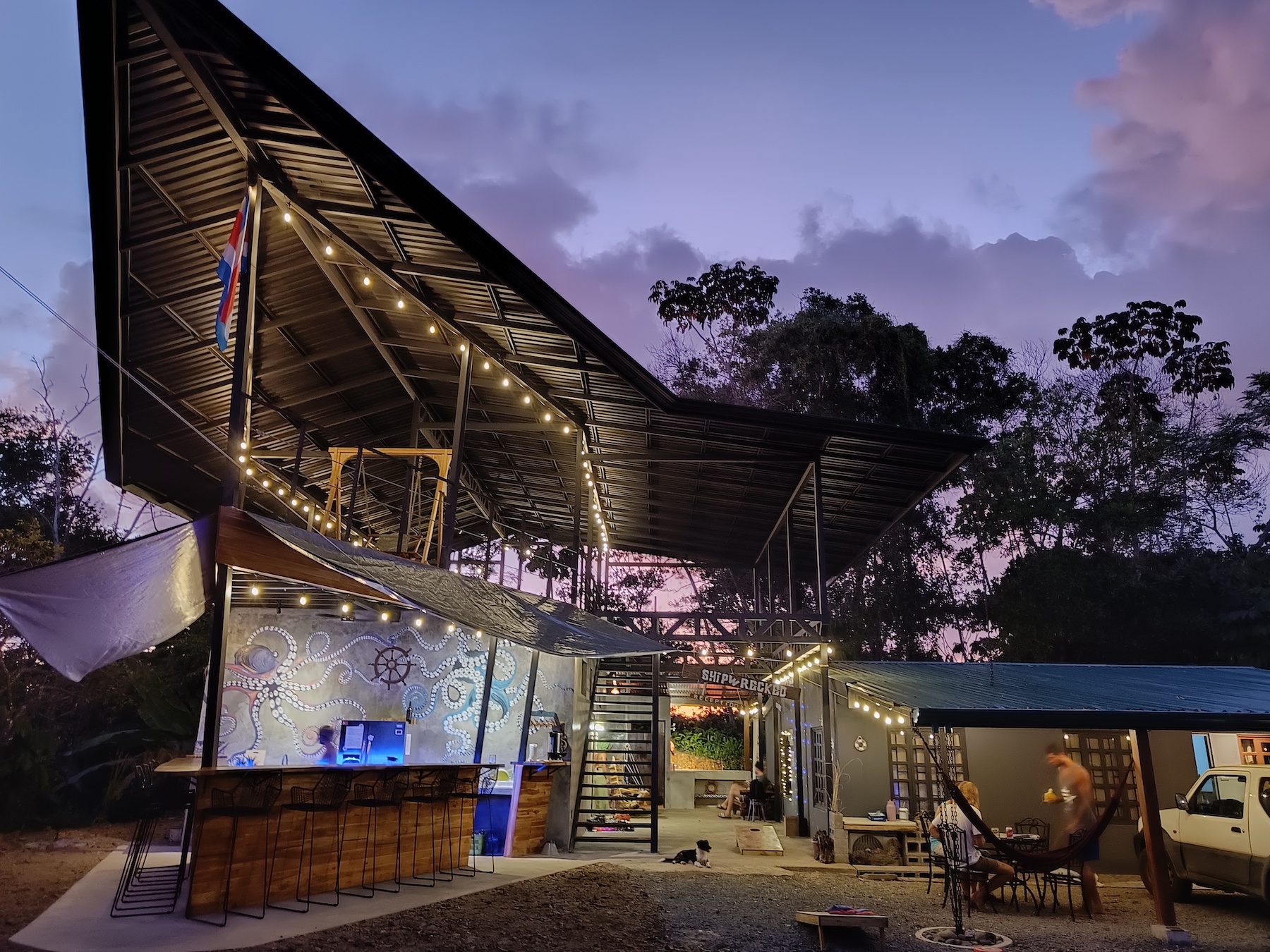
Shipwrecked Hostel is a cheerful, budget-focused spot on Paseo de los Turistas, Puntarenas’s beachfront promenade. The lobby smells of salt and coffee, with mismatched surfboards on the walls and a notice board full of local tour deals. It’s aimed at backpackers and solo travellers who want a dorm bed or a cheap private room, with a shared kitchen, hammock area, and a small pool. You’ll hear English, Spanish, and German spoken at the check-in desk.
Chronicles of Puntarenas
Puntarenas was founded in the 1840s as a port for exporting coffee and later bananas, served by the Pacific Railway from San José. The city expanded along the sand spit that gives it its name—'Punta de Arenas', meaning point of sands. Its heyday was the mid-20th century, when cruise ships and beach hotels made it Costa Rica’s original tourist hub. The 1990s saw a decline as visitors shifted to Pacific resorts like Jacó, but Puntarenas retains a faded, workaday character with a lively malecón, ferry terminal for the Nicoya Peninsula, and a strong fishing culture centered on the Mercado Central.
Best Time to Visit
Full Puntarenas guide →Best months
January to March: driest months with clear skies, ocean calm, and fewer crowds than the peak Christmas–New Year period. Also June: start of the green season, quieter but still warm.
Peak / festival surge
Late December to early January (Christmas and New Year) and Easter week (Semana Santa). The city fills with national and international visitors, hotel prices double or triple, and the beaches get packed. The Fiesta de los Diablitos in early March can also bump up demand.
Budget shoulder season
Late November to early December, and mid-April to late May. Rain is light, temperatures are high, and rooms are significantly cheaper than in peak season—often 40–50% less.
Weather & packing
Puntarenas is hot and humid year-round, with temperatures rarely below 25°C. Pack only lightweight, quick-dry clothing, a rain jacket (even in dry season), reef-safe sunscreen, and a hat—and accept you’ll be sweating within 10 minutes of stepping outside.
Live City Briefing — Puntarenas
- The new Puntarenas–Tivives coastal highway, opened in 2025, has cut driving time from San José by about 20 minutes—expect roughly 1.5 hours now, but still variable due to traffic.
- A major renovation of the Malecón (seafront walkway) began in early 2026, with sections near the hostel closed for paving until late August—access to the beach remains open via side streets.
- Seasonal note: July is part of the green (rainy) season—afternoon downpours are common from 1–4pm, so plan morning outdoor activities and carry a waterproof daypack.
Your Perfect Room
✨ AI-generated · Jul 2026Before you check in to Shipwrecked Hostel, here's what to know about choosing the right room.
Best rooms to request
Request a room on the second floor or above, facing away from Carretera Pacífica Fernández Oreamuno (i.e., towards the interior or the rear of the building). This reduces road noise from the main coastal road. If available, ask for a room with a window overlooking the quieter side or courtyard.
Rooms to avoid
Avoid ground-floor rooms, especially those at the front of the building facing the main road. They’ll catch the most noise from traffic, pedestrians, and any late-night activity on Carretera Pacífica Fernández Oreamuno. Also skip rooms near any communal areas like the lobby or common kitchen if the hostel has one.
Best views
Rooms at the front on upper floors might offer a partial view of the Gulf of Nicoya, as the address is on the coastal road. But the main view is likely the street and some urban Puntarenas. Rear rooms face quieter residential or inland areas – no view but better sleep.
Quietest floors
Second floor and above. Since no lift is mentioned for a 3-star hostel in a low-rise building, higher floors are quieter but require stairs. Third floor (if exists) would be best for quiet, but check accessibility.
🔊 Noise notes
Main road noise from Carretera Pacífica Fernández Oreamuno, a busy coastal artery with cars, buses, and motorcycles, especially during daytime. At night it may quiet down but still sporadic. No indication of nightclub or bar on-site, but as a hostel, social noise from common areas is possible.
Insider tips
1. Check in early to secure a top-floor room away from the road – there’s no lift, so dragging luggage up is easier in daylight. 2. If you drive, ask about parking: the street is likely metered or tight – the hostel may have a dedicated spot or a nearby lot for a small fee.
- Call the hotel directly 24–48 hours before arrival and ask for a specific room type
- Add a note in your booking comments field
- Ask at check-in — front desk staff can often accommodate if a room is available
Hotel Facilities — Shipwrecked Hostel
Free WiFi (gigabit fiber) across all areas; no login required, no speed cap. A premium tier ($5 USD/¢2,625 CRC per day) for dedicated high-bandwidth connection is sold at reception
No lift. Two-storey building with stairs only; no accessibility lift
No digital newsstand or physical papers. Common area has a bookshelf with travel guides and local maps
Check-in from 14:00; early bag-drop from 09:00 (free). Late check-out until 14:00 for $10 USD (¢5,250 CRC), after 14:00 charged for extra night. Last check-in strictly 23:00
Free luggage storage in locked room; open 07:00-22:00. After 22:00, leave with receptionist (subject to availability)
No step-free access. Main entrance has three steps; no ramp. Doors 80cm wide. Wheelchair users may find stair-only access and narrow corridors prohibitive
No on-site parking. Nearest public car park: Estacionamiento El Muelle (2 blocks east) costs ¢1,500 CRC/hour or ¢8,000 CRC (about $15 USD) overnight. No EV charging
Fees, Taxes & Deposits
City / tourist tax: None (no local city tax applies in Puntarenas; 13% VAT is included in quoted rates)
Deposit & card hold: Full prepayment required at booking via card; a $20 USD (¢10,500 CRC) incidental hold placed on card at check-in
Faith & Dietary Nearby
- Church: Iglesia de Bahía (363 m · ~5 min walk)
Local Lifestyle & Recreation
Plaza Alfaro — 2.0 km · ~25 min walk
Parque de Bahía — 185 m · ~2 min walk
5-Minute Radius Essentials
Banco Nacional — 1.4 km · ~18 min walk
Farmacia Ibarra — 1.5 km · ~19 min walk
Mini Super Don Freddy — 117 m · ~1 min walk
Estación de buses Tracopa — 1.9 km · ~23 min walk
Money & Currency
Get a travel card →Costa Rican Colón, CRC
ATMs in Puntarenas give the best rates; avoid exchange bureaux at Juan Santamaría Airport and tourist areas as they charge poor rates.
Visa/Mastercard are widely accepted in supermarkets and hotels; Amex less so; small shops and street vendors are cash-only.
A 10% service charge is often added to restaurant bills, so no extra tip required; leave small change for taxis; hotel staff appreciate 500–1000 CRC per bag.
Eat, Shop & Travel on a Budget
Cheap car hire →A cafetería or bakery sells a small coffee for around 500 CRC.
A casado (rice, beans, plantain, salad, protein) from a soda (family-run diner) costs about 2500–3000 CRC.
A main course of grilled fish or chicken with sides at a local marinera (beachfront eatery) runs 3500–4500 CRC.
The Paseo de los Turistas and central market area have food carts and small stalls selling tacos, empanadas, and fruit cups for under 1500 CRC.
Supermercado Maxi Pali and Más x Menos are common budget supermarket chains in Puntarenas.
The central market has affordable clothing stalls; for basics, try the Puntarenas branch of Super Cocina.
Local buses cost about 250 CRC per ride; from Juan Santamaría Airport, take bus route 500 (San José–Puntarenas) for about 2000 CRC.
Eat at sodas for budget meals rather than tourist-oriented restaurants. Buy bottled water and snacks at supermarkets, not at beachfront stalls. Use local buses instead of taxis for short trips.
Emergency Contacts
PuntarenasIn Costa Rica, 911 connects you to police, ambulance, and fire services. For non-emergencies, the Puntarenas police station is on Avenida 3, Calles 2/4, +506 2661-0144. The local fire station (Bomberos) is at Calle 6, Avenida 5, +506 2661-0111. The Red Cross ambulance can also be reached at +506 2661-0222. Keep these written down, as phone battery can be an issue.
💡 Save these numbers in your phone. In life-threatening emergencies, call immediately.
Where to Eat
💡 Booking tip: For popular restaurants in Puntarenas, book at least a week ahead — especially for weekend evenings and during festival season.
Your arrival at Shipwrecked Hostel
🕒 Check-in is from . Arriving earlier? Most hotels store luggage free — just ask at reception.
🧭 First things nearby: cash · Banco Nacional — 1.4 km · ~18 min walk — pharmacy · Farmacia Ibarra — 1.5 km · ~19 min walk
🚐 Pre-book an airport transfer →Getting Around
Puntarenas main bus terminal → Hotel Porto Bello
💡 These three-wheeled taxis are quicker through Puntarenas narrow streets. Confirm the price before hopping in — locals usually pay 1,500–2,000 CRC. They’re not suitable for luggage-heavy trips.
San José (Coca-Cola terminal) → Puntarenas main terminal
💡 From hotel, take a short taxi (2 km) to the Puntarenas terminal. Buses are reliable but can be crowded. Bring small bills for exact fare. The air conditioning works on newer coaches.
Puntarenas city centre (Avenida Central stop) → Hotel Porto Bello (beachfront road)
💡 Flag down any bus marked 'Caldera' or 'Barranca' along the coastal road. Tell the driver you want Hotel Porto Bello — they'll drop you near the entrance. Exact coins are preferred.
Juan Santamaría International Airport (SJO) → Hotel Porto Bello, Puntarenas
💡 Use the official airport taxi service (orange cars) from the booth outside arrivals. Avoid unlicensed drivers. Negotiate the fare before you get in — 80,000 CRC is standard for this route.
About Puntarenas
Wikipedia ↗
Puntarenas (Spanish pronunciation: [puntaˈɾenas]) is a city in the Puntarenas Province, on the Pacific coast of Costa Rica. As the seat of the Municipality of Puntarenas canton, it is awarded the title of city, which comprises the Puntarenas, Chacarita and El Roble districts. As the city of the firs...
Frequently Asked Questions
What are the best rooms at Shipwrecked Hostel?
Request a room on the second floor or above, facing away from Carretera Pacífica Fernández Oreamuno (i.e., towards the interior or the rear of the building). This reduces road noise from the main coastal road. If available, ask for a room with a window overlooking the quieter side or courtyard.
Which rooms should I avoid at Shipwrecked Hostel?
Avoid ground-floor rooms, especially those at the front of the building facing the main road. They’ll catch the most noise from traffic, pedestrians, and any late-night activity on Carretera Pacífica Fernández Oreamuno. Also skip rooms near any communal areas like the lobby or common kitchen if the hostel has one.
Is Shipwrecked Hostel noisy?
Main road noise from Carretera Pacífica Fernández Oreamuno, a busy coastal artery with cars, buses, and motorcycles, especially during daytime. At night it may quiet down but still sporadic. No indication of nightclub or bar on-site, but as a hostel, social noise from common areas is possible.
Which rooms have the best views at Shipwrecked Hostel?
Rooms at the front on upper floors might offer a partial view of the Gulf of Nicoya, as the address is on the coastal road. But the main view is likely the street and some urban Puntarenas. Rear rooms face quieter residential or inland areas – no view but better sleep.
What are insider tips for staying at Shipwrecked Hostel?
1. Check in early to secure a top-floor room away from the road – there’s no lift, so dragging luggage up is easier in daylight. 2. If you drive, ask about parking: the street is likely metered or tight – the hostel may have a dedicated spot or a nearby lot for a small fee.
What time is check-in at Shipwrecked Hostel?
Check-in at Shipwrecked Hostel is from null. Check-out is by null.
Does Shipwrecked Hostel have Wi-Fi?
Free WiFi (gigabit fiber) across all areas; no login required, no speed cap. A premium tier ($5 USD/¢2,625 CRC per day) for dedicated high-bandwidth connection is sold at reception
Is there a city or tourist tax at Shipwrecked Hostel?
None (no local city tax applies in Puntarenas; 13% VAT is included in quoted rates)
Where can I eat cheaply near Shipwrecked Hostel?
A casado (rice, beans, plantain, salad, protein) from a soda (family-run diner) costs about 2500–3000 CRC.
What is the cheapest way to get around from Shipwrecked Hostel?
Local buses cost about 250 CRC per ride; from Juan Santamaría Airport, take bus route 500 (San José–Puntarenas) for about 2000 CRC.
When is the best time to visit Puntarenas?
January to March: driest months with clear skies, ocean calm, and fewer crowds than the peak Christmas–New Year period. Also June: start of the green season, quieter but still warm.
Top Attractions in Puntarenas
💡 Rent a bicycle from one of the small shops near the pier (about $3/hour) and ride the full length early in the morning. The stretch near the port has the best sea breezes.
💡 Go an hour before sunset and buy a coconut from the vendors near the entrance. The pier is busiest on weekends but still peaceful in the early morning.
💡 Look up at the painted ceiling panels near the altar. If the church is closed, the surrounding park has benches in the shade and good people-watching.
💡 Entry is 1,500 colones (about $3). The volunteer guides are elderly locals with great stories – ask them about the 1920s banana trade or the 1950 ferry disaster. Allow 30–40 minutes.
💡 Entry is about 4,000 colones (under $8) for adults. Go on a weekday morning to avoid school groups. The outdoor turtle pond is easy to miss – look for it past the main building.