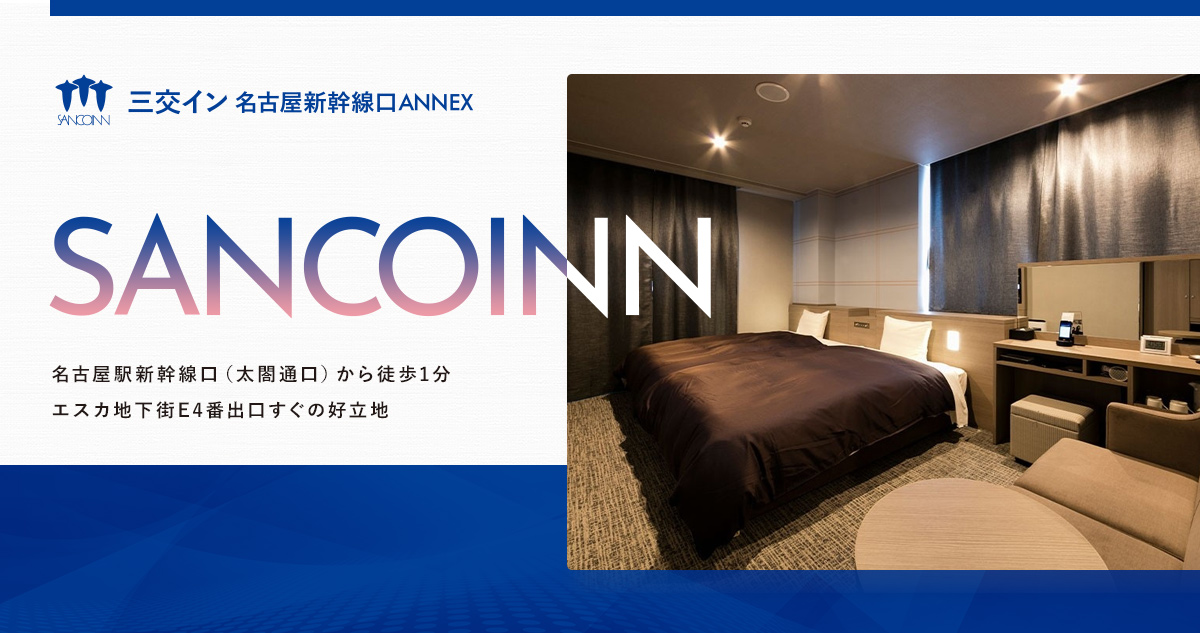
Photo: official website
Votre séjour — 三交イン名古屋新幹線口ANNEX
Prévisions en direct pour vos dates · Quoi de neuf · Qualité de l'air et pollen📅 Pick your check-in & check-out above to unlock your day-by-day forecast, what's on during your stay, and live air quality & pollen for Nagoya.
La propriété — 三交イン名古屋新幹線口ANNEX
A functional, mid-range business hotel two minutes on foot from the Shinkansen platform. The lobby is compact and efficient: a small seating area, automated check-in kiosks, and a free coffee machine for guests. It suits solo travellers or couples who want a clean, no-nonsense room near the station for a single night.
Chroniques de Nagoya
Nagoya began as the castle town of the Owari branch of the Tokugawa clan, with its iconic castle completed in 1612. Allied bombing flattened much of the city in 1945, and the post-war rebuild favoured concrete and wide roads. Today, it is Japan’s fourth-largest city and a gritty industrial hub, home to Toyota’s global headquarters and the aviation and ceramics industries. Culturally, it blends Aichi’s strong regional identity with a pragmatic, business-first character: fewer temples, more factories. The people speak a distinct dialect and swear by miso-based dishes and local kishimen flat noodles.
Meilleur moment pour visiter
Guide complet de Nagoya →Meilleurs mois
October and November: clear skies, pleasant temperatures (15-20°C), and autumn colours at Tokugawaen garden. Crowds are moderate. May is also good, though the Golden Week holiday (first week) spikes visitor numbers and prices.
Peak / Festival surge
July and August. July has the Port Festival (Natsumatsuri) and the Osu Summer Festival with street stalls and taiko drumming. August is humid with daily highs above 32°C. Hotel prices jump sharply; book well ahead for any weekend.
La saison des épaules
September and June. June is the start of the rainy season but often less crowded; September sees lingering heat but cheaper rates as families finish summer trips. Best for discounts if you can handle occasional rain and humidity.
Météo & Emballage
Nagoya in July is fiercely humid, with frequent showers and temperatures above 30°C. Pack breathable cotton or moisture-wicking clothes plus a compact waterproof jacket (not an umbrella – rain often comes sideways).
Briefing de la ville — Nagoya
- The Nagoya City Science Museum’s planetarium reopens in July 2026 after a year-long refurbishment; bookings are strongly recommended.
- A section of the Sakuramichi-dori, the road running south from the station, is closed for utility works until August; the Meitetsu bus service 1-3 has a revised stop.
- The annual Nagoya Osu Summer Festival runs 12-14 July 2026, featuring a mikoshi parade and evening food stalls; expect heavier crowds near Osu Kannon.
Your Perfect Room
✨ AI-generated · Jul 2026Before you check in to 三交イン名古屋新幹線口ANNEX, here's what to know about choosing the right room.
Best rooms to request
Request rooms on floors 8–10 facing away from the main street (look for rooms ending in odd numbers if the corridor layout allows). These floors minimise street and lobby noise while keeping you out of the peak lift traffic.
Rooms to avoid
Avoid rooms on floors 1–3: they sit at street level and pick up traffic noise from the Nagoya Station area, plus foot traffic from the main road. Also avoid rooms directly above the lobby (usually floor 2) where you'll hear people and luggage carts.
Best views
Limited due to location next to an elevated expressway and buildings, but south-facing rooms (towards the station) get a view of the Sakura-dori tower and station plaza. East-facing rooms see the Nagoya skyline at a distance.
Quietest floors
Floors 6–10 are the quietest — well above street drag and below the roof machinery, with fewer guests passing through.
🔊 Noise notes
Street noise from the main road along the Shinkansen side is constant, particularly early morning and evening. The hotel sits near the busy Meiko Expressway entry, so low-flying motorbikes and trucks are audible on lower street-facing floors. There's also a convenience store and taxi rank near the entrance, adding occasional chatter.
Insider tips
1. Request a room on the 'annex wing' side if offered — it's set back from the road. 2. Use the self-check-in kiosk in the lobby (fast and avoids queueing) and ask for a top-floor corner room if available; they sometimes have slightly more space and a window on two sides.
- Call the hotel directly 24–48 hours before arrival and ask for a specific room type
- Add a note in your booking comments field
- Ask at check-in — front desk staff can often accommodate if a room is available
Hôtel Facilités — 三交イン名古屋新幹線口ANNEX
Free throughout, no login needed; speed adequate for browsing and streaming, about 20–40 Mbps down.
Two lifts serving all floors (2nd to 12th); no stairs-only sections.
Free digital newspaper via tablet in lobby (Nikkei/Asahi); no physical papers delivered to rooms.
Check-in from 15:00; early bag-drop from 10:00 (free at front desk). Late check-out until 12:00 costs ¥1,000 per room, after 12:00 charged as half-day rate.
Free storage at front desk for same-day drop before check-in and after check-out; no storage for multiple days.
Step-free entrance from street; one wheelchair-accessible room type available, but no lift to rooftop or certain hallways (width constraints).
No on-site parking; nearest public car park is Times Sakae 4-chome (3-min walk, ¥1,200/24h). No EV charging.
Frais, taxes et dépôts
City / tourist tax: ¥200 per person per night for stays over ¥10,000; ¥300 per person per night for stays over ¥15,000; waived for bookings under ¥10,000
Deposit & card hold: Full prepayment required at booking for non-refundable plans; refundable plans hold ¥5,000 incidental deposit via card imprint at check-in, released at check-out
Faith & Dietary à proximité
- Buddhist temple: 大誠寺 (109 m · ~1 min walk)
- Place of worship: 稲穂社 (209 m · ~3 min walk)
- Place of worship: 須左之男社 (218 m · ~3 min walk)
- Buddhist temple: 願王寺 (218 m · ~3 min walk)
Style de vie et récréation
JRセントラルタワーズ — 659 m · ~8 min walk
牧野公園 — 156 m · ~2 min walk
ウエストベスギャラリー コヅカ — 1.4 km · ~17 min walk
KABUKI CAFE NAGOYAZA — 2.0 km · ~25 min walk
どんぐりひろば — 536 m · ~7 min walk
5 minutes de radios essentielles
三菱UFJ銀行 — 912 m · ~11 min walk
スマイル薬局 — 203 m · ~3 min walk
ファミリーマート — 113 m · ~1 min walk
名古屋 — 446 m · ~6 min walk
Monnaie & Monnaie
Get a travel card →Japanese Yen, JPY
Use ATMs at 7-Eleven or Japan Post for the best rates; avoid currency exchange at airports or tourist bureaux as they charge high fees.
Credit cards are accepted in most chain stores and restaurants, but smaller shops and local eateries often only take cash; contactless (Suica, etc.) works on transit and many convenience stores.
Tipping is not practised or expected in Japan; just pay the bill as shown.
Manger, faire du shopping et voyager sur un budget
Cheap car hire →A can of hot or cold coffee from a vending machine costs about ¥120.
A set meal (teishoku) at a chain like Yoshinoya or Matsuya costs roughly ¥500–¥700.
A bowl of ramen from a local shop costs around ¥800–¥1,000.
The Nagoya Station area and Osu Kannon Temple grounds have food stalls and small shops selling takoyaki, yakitori, and taiyaki (¥200–¥500 each).
Supermarket chains include AEON, MaxValu, and Don Quijote (for basics).
UNIQLO and GU are the main affordable high-street options around Nagoya Station and Sakae.
The cheapest way around is the subway day pass (¥760) or the Me~guru bus day pass (¥500); from Chubu Centrair Airport take the Meitetsu Limited Express (¥1,230) to Nagoya Station.
1. Buy a rechargeable transit IC card (e.g., manaca) at any station for contactless travel. 2. Eat lunch at department store basement food halls for ready-made meals at half the restaurant price. 3. Visit on the 8th of each month for ‘Fujin no Hi’—many museums and attractions offer free entry.
Bon à savoir — Nagoya
Type A/B · 100V
safe
$1 ≈ ¥162.38 · JPY
Where to Eat
💡 Booking tip: For popular restaurants in Nagoya, book at least a week ahead — especially for weekend evenings and during festival season.
Your arrival at 三交イン名古屋新幹線口ANNEX
🕒 Check-in is from . Arriving earlier? Most hotels store luggage free — just ask at reception.
🧭 First things nearby: cash · 三菱UFJ銀行 — 912 m · ~11 min walk — pharmacy · スマイル薬局 — 203 m · ~3 min walk
🚐 Pre-book an airport transfer →S’entourer
Chubu Centrair International Airport (NGO) → Nagoya Station (then taxi/walk to LIMOUSINE HOTEL)
💡 The μSky is faster and has luggage racks—pay the extra ¥360 for a reserved seat to avoid standing. From Nagoya Station, it's a 10-minute walk or ¥1,000 taxi to the hotel.
Chubu Centrair International Airport (NGO) → LIMOUSINE HOTEL (via Nagoya Station, then 5-min taxi or 10-min walk)
💡 Get off at Nagoya Station, then catch a 5-minute taxi to the hotel—don't bother with local buses; the walk is doable if you're light, but it's a bit of a maze underground.
Chubu Centrair International Airport (NGO) → LIMOUSINE HOTEL
💡 Use the fixed-rate taxi counter at the arrivals hall—avoid metered cabs as they can cost 30% more. Good for late arrivals or heavy luggage, but book ahead during peak hours.
Nagoya Station (Meijo Line platform) → LIMOUSINE HOTEL (nearest station: Yagoto Nisseki)
💡 From Nagoya Station, take the Meijo Line to Yagoto Nisseki—it's a 3-minute walk from Exit 5. Buy an IC card (Manaca) at any ticket machine; it saves fumbling for coins and works on buses too.
Questions fréquemment posées
What are the best rooms at 三交イン名古屋新幹線口ANNEX?
Request rooms on floors 8–10 facing away from the main street (look for rooms ending in odd numbers if the corridor layout allows). These floors minimise street and lobby noise while keeping you out of the peak lift traffic.
Which rooms should I avoid at 三交イン名古屋新幹線口ANNEX?
Avoid rooms on floors 1–3: they sit at street level and pick up traffic noise from the Nagoya Station area, plus foot traffic from the main road. Also avoid rooms directly above the lobby (usually floor 2) where you'll hear people and luggage carts.
Is 三交イン名古屋新幹線口ANNEX noisy?
Street noise from the main road along the Shinkansen side is constant, particularly early morning and evening. The hotel sits near the busy Meiko Expressway entry, so low-flying motorbikes and trucks are audible on lower street-facing floors. There's also a convenience store and taxi rank near the entrance, adding occasional chatter.
Which rooms have the best views at 三交イン名古屋新幹線口ANNEX?
Limited due to location next to an elevated expressway and buildings, but south-facing rooms (towards the station) get a view of the Sakura-dori tower and station plaza. East-facing rooms see the Nagoya skyline at a distance.
What are insider tips for staying at 三交イン名古屋新幹線口ANNEX?
1. Request a room on the 'annex wing' side if offered — it's set back from the road. 2. Use the self-check-in kiosk in the lobby (fast and avoids queueing) and ask for a top-floor corner room if available; they sometimes have slightly more space and a window on two sides.
What time is check-in at 三交イン名古屋新幹線口ANNEX?
Check-in at 三交イン名古屋新幹線口ANNEX is from null. Check-out is by null.
Does 三交イン名古屋新幹線口ANNEX have Wi-Fi?
Free throughout, no login needed; speed adequate for browsing and streaming, about 20–40 Mbps down.
Is there a city or tourist tax at 三交イン名古屋新幹線口ANNEX?
¥200 per person per night for stays over ¥10,000; ¥300 per person per night for stays over ¥15,000; waived for bookings under ¥10,000
Where can I eat cheaply near 三交イン名古屋新幹線口ANNEX?
A set meal (teishoku) at a chain like Yoshinoya or Matsuya costs roughly ¥500–¥700.
What is the cheapest way to get around from 三交イン名古屋新幹線口ANNEX?
The cheapest way around is the subway day pass (¥760) or the Me~guru bus day pass (¥500); from Chubu Centrair Airport take the Meitetsu Limited Express (¥1,230) to Nagoya Station.
When is the best time to visit Nagoya?
October and November: clear skies, pleasant temperatures (15-20°C), and autumn colours at Tokugawaen garden. Crowds are moderate. May is also good, though the Golden Week holiday (first week) spikes visitor numbers and prices.
Principales attractions à Nagoya
💡 The temple is free, but the arcade's second-hand shops are the real draw. Try the local miso skewers from street vendors for 100 yen.
💡 The inner keep costs 500 yen, but you can see the stone walls and moat for free. Visit early morning to avoid crowds.
💡 The inner garden costs 300 yen, but the outer paths give you 90% of the experience. Bring a snack for the benches by the koi pond.
💡 Stick to the free outdoor section—see the old looms and early Toyota cars. The indoor part is worth it only if you're an engineering buff.
💡 The treasury museum costs 500 yen, but skip it—the main shrine grounds are the highlight. Go at noon for the daily Shinto ceremony.